opengear
SECURE REMOTE ACCESS OF YOUR CRITICAL NETWORK RESOURCES
Managing modern networks requires solutions that are dynamic, secure, and scalable. Opengear’s Smart Management Fabric (SMF) delivers on all fronts, providing a unified framework for out-of-band management that enhances your network’s resilience and efficiency. From dynamic routing-based IP access to advanced security features, SMF ensures that your infrastructure is always connected and secure.
To learn how SMF can transform your network operations, check out our solution overview sheet. Discover how to optimize your network’s performance and ensure business continuity in any scenario.
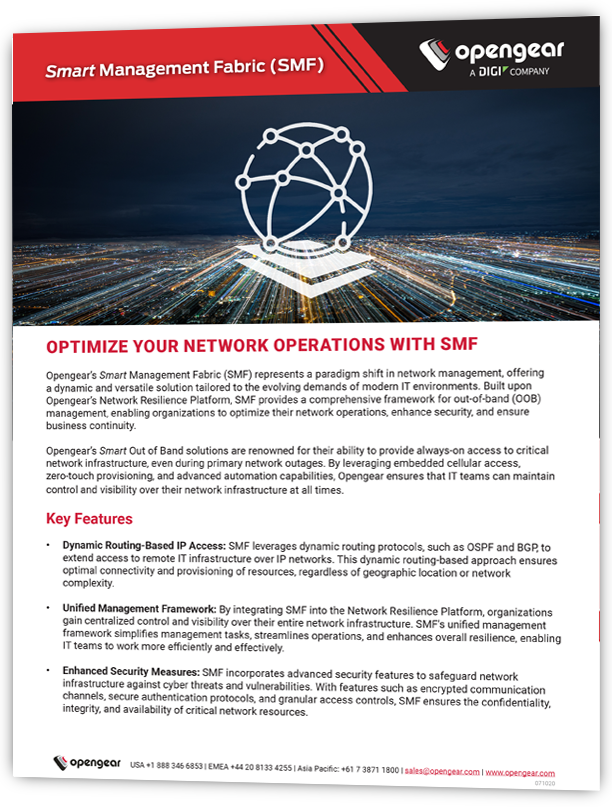
Ensuring uptime, security, and scalability are critical in today’s complex network environments. Opengear’s Smart Management Fabric (SMF) is designed to address these challenges head-on, offering robust features like dynamic routing-based IP access, centralized management, and advanced security measures.
To see how SMF can revolutionize your network operations, explore our infographic. Discover the key benefits and features that make SMF an essential tool for modern network management.
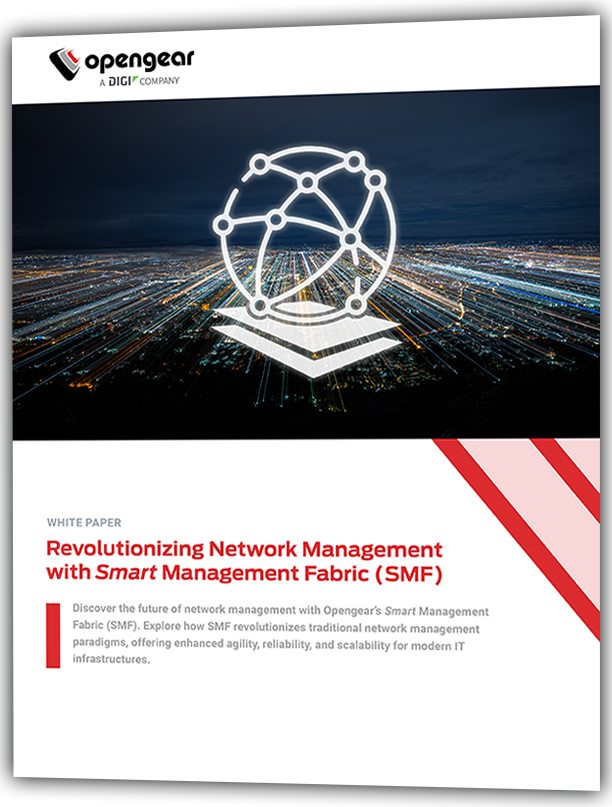
Traditional network management methods often struggle with complexity, scalability, and security. Enter Smart Management Fabric (SMF) by Opengear. SMF integrates routed IP connectivity into our Network Resilience Platform, offering dynamic, agile solutions for modern network challenges. It ensures secure access during outages, minimizes downtime, and supports your network’s growth.
If you’re looking to achieve network resilience and overcome the challenges of modern network management, download our white paper today!
The next generation of wireless technology is here. 5G will enhance connectivity across all platforms, providing more efficient, faster and better signal strength which opens doors for new possibilities across cellular networks. It is predicted that by 2024 more than 1.5 billion devices will be connected to 5G.1 So how will 5G enhance your cellular connectivity?
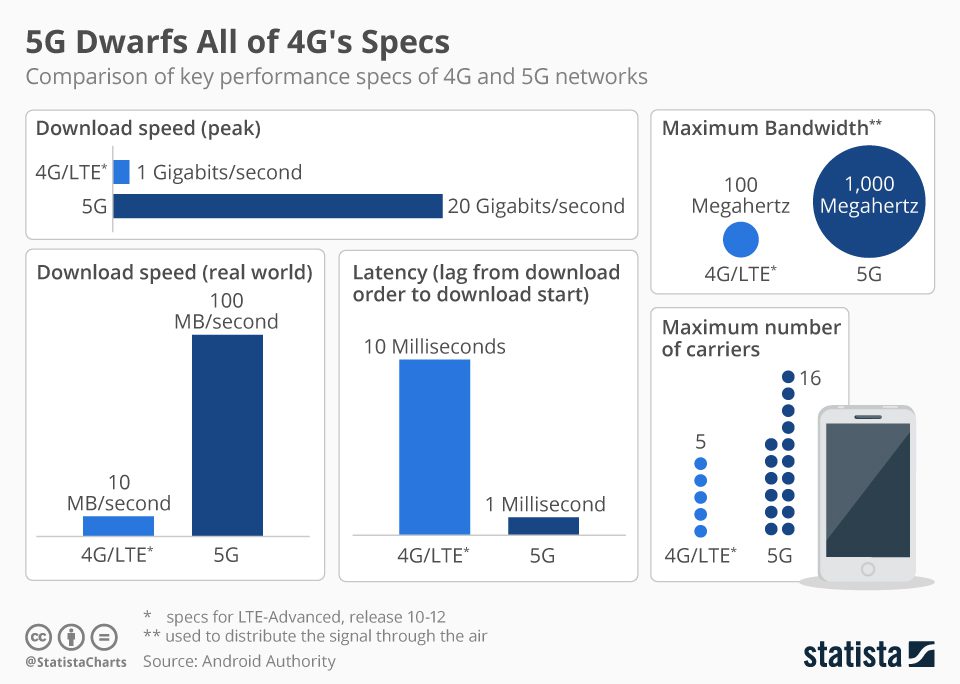 Ref: Statista
5G will be a strong enabler in the expansion of the Internet of Things (IoT), given the speed and versatility it will bring to networks. 5G has a range of benefits when compared to 4G, based on its use of the 30 GHz to 300 GHz spectrum:
5G is gradually being rolled out, so later iterations are expected to have even stronger capabilities.
It’s important to note that 5G, unlike previous iterations, is not expected to replace 4G. Many applications, such as standard mobile phone calls and low-data transactions, will still be carried on a 4G network, with 5G being applied primarily to large-compute and low-latency uses.
Given the higher frequency spectrum, 5G also requires a higher density of towers to cover a given area, meaning that rollout of 5G will initially be limited to metropolitan areas. It is also impacted more severely by physical barriers such as walls, trees, and even bad weather.
Compute locations are moving increasingly to the edge, driven by the growth of IoT and the desire to process and prioritize data closer to the collection point. Faster connections associated with 5G will support that migration as enterprises distribute their network power between Data Centers, Cloud Computing and the Edge.
The low latency and high speed of 5G particularly suit applications such as consumer VR/AR, AI, and autonomous vehicles, with high data density and rapid response requirements, enabling faster adoption of these technologies.
Users expect the same level of uptime and response from their network, regardless of where that compute is located. But the reality of edge locations is that the type of system redundancy and staffing that is typical at data centers are not feasible at each location. Reliable, always-on access to the network devices, via out-of-band management, is a critical component of that network resilience.
As levels of automation continue to increase, enterprises will also have to extend the reach of their management and monitoring tools. Opengear solutions anticipate the current and future network needs of 5G.
Opengear smart solutions provide engineers at the Network Operations Center (NOC) with the ability to reach devices located at the edge. Lighthouse ensures access and visibility remotely, during critical failures while Smart Out-of-Band provides advanced troubleshooting to remediate issues that may arise at the network’s edge. The NetOps Automation platform provides additional functionality to streamline repetitive workflows such as secure provisioning and event management.
Each organization has a core IT infrastructure and line of business applications. Constantly improving technologies provide an opportunity to help them operate more efficiently. Once the right technologies have been identified, enterprises must identify the right moment to get on board to ensure meaningful results.
For 5G specifically, determining the right time to act requires understanding the most immediate use cases for it within the enterprise. The first is fixed internet connectivity. Instead of using cable, satellite or copper wires/ADSL, edge locations could potentially use 5G to get fixed internet connectivity. Because this eliminates the need for burdensome physical cables and wires, 5G may provide an easier method for deployment.
For many enterprises, it is too early to fully embrace 5G. Unless there are already specific applications that are limited by speed/latency of existing connectivity technologies, the value of deploying it will not yet be realized. Instead, the focus, for now, should be on understanding the technology at a high level and identifying the use cases that are likely to benefit the business most so that they can be prioritized when 5G becomes readily available.
1 https://www.ericsson.com/assets/local/mobility-report/documents/2019/ericsson-mobility-report-june-2019.pdf
2 https://www.digitaltrends.com/mobile/5g-vs-4g/
3 https://www.androidauthority.com/what-is-5g-explained-944868/
Hyperscale data centers allow some of the largest technology organizations in the world, like Google, Facebook and Amazon, to maintain reliability and speed.
Hyperscale refers to the architecture of a data center and its ability to scale in response to increasing demand. This involves increasing memory, storage resources and infrastructure. The goal of scaling is to not only continue to build a system, but to do it big and fast. These massive systems are constantly rolling out new features. Because of this growth providers are prioritizing connectivity and availability – for this, they need a highly reliable solution.
Hyperscale data centers house thousands of devices and although their modular design allows operators to easily add resources as needed, their sheer size creates network visibility challenges. Constantly growing, operators are running into challenges that are causing outages and downtime. An alternative path to devices located at remote sites, 5G powered Smart Out-of-Band (Smart OOB™) allows hyperscale providers to maintain connectivity if this occurs. Operators are able to securely monitor and access all devices without impacting normal operations to ensure business continuity.
When an error occurs, locating the exact router that is experiencing an issue can take hours or days without the right solution. Using Smart OOB operators are able to automatically find where an error has occurred and if it can be remediated or needs to be replaced to ensure business continuity.
Zero Touch Provisioning allows hyperscale providers to deploy large-scale IT infrastructure to automate the initial setup – repetitive tasks are reduced, human touch points are decreased, and errors are lessened. Customizable scripting and files allow ZTP to be flexible in any environment. It allows hyperscale providers to remove the human factor and enable mass provisioning through the rack.
Zero Touch Deployment from Opengear
Simplifying secure deployments
The Network Resilience Platform allows providers to provision new networks remotely and securely. Serving as a single point of reference, control, and convenience for the IT and network organizations, it automates initial device setup with zero-touch provisioning, provides an aggregated view of the management network (OOB), and enables management of everyday operations with ease.
DevOps tools are increasingly applied to networking, creating a NetOps approach to building and maintaining a reliable infrastructure to support the virtualized world – a network that is both available and agile. One approach to introducing NetOps into an enterprise is to layer it into an existing solution, adding functionality and flexibility to a familiar component of your infrastructure.
A Smart Out-of-Band management network already provides presence and proximity to your critical devices, and so is well-placed to bring NetOps automation to your network. The ability to run standard NetOps tools, such as Docker, Ansible, and Python on a console server provides a new way to automate your operations at centralized and remote locations.

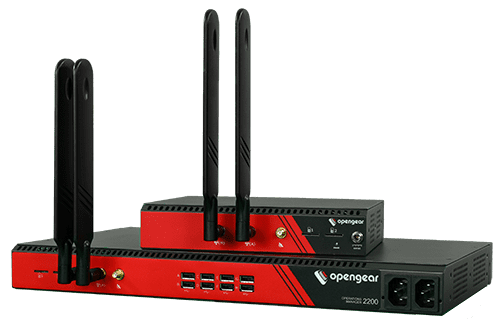
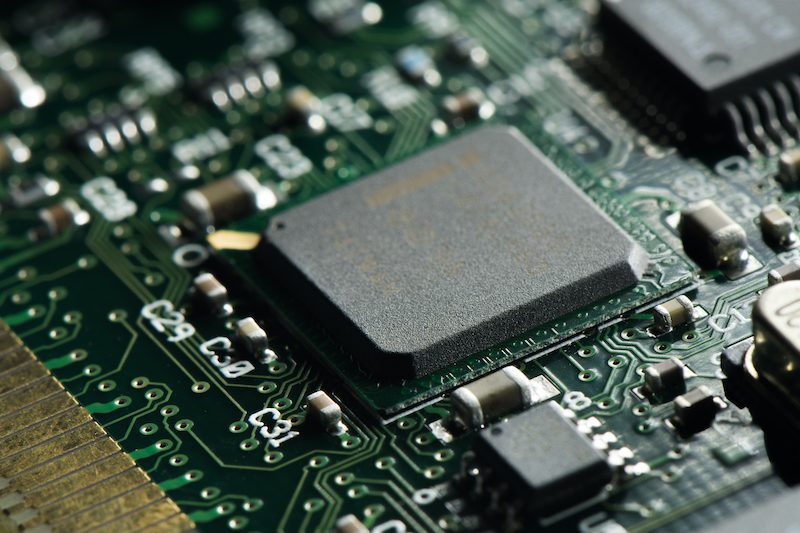
That solution now exists, in the new Opengear OM Family of Console Servers – Network Management appliances that combine the capabilities of a Smart OOB Console Server with the flexibility of NetOps Automation. They feature an x86 CPU to power automation tools, and a TMP2.0 chip for embedded security.
The compact OM1200 appliance is designed specifically for secure edge deployments, used in combination with Lighthouse Software, while the OM2200 appliance is configured for data centers and high density locations.
Integrated into Opengear’s Network Resilience Platform, they provide a separate, secure management plane which supports emerging requirements in Network Management and Automation.
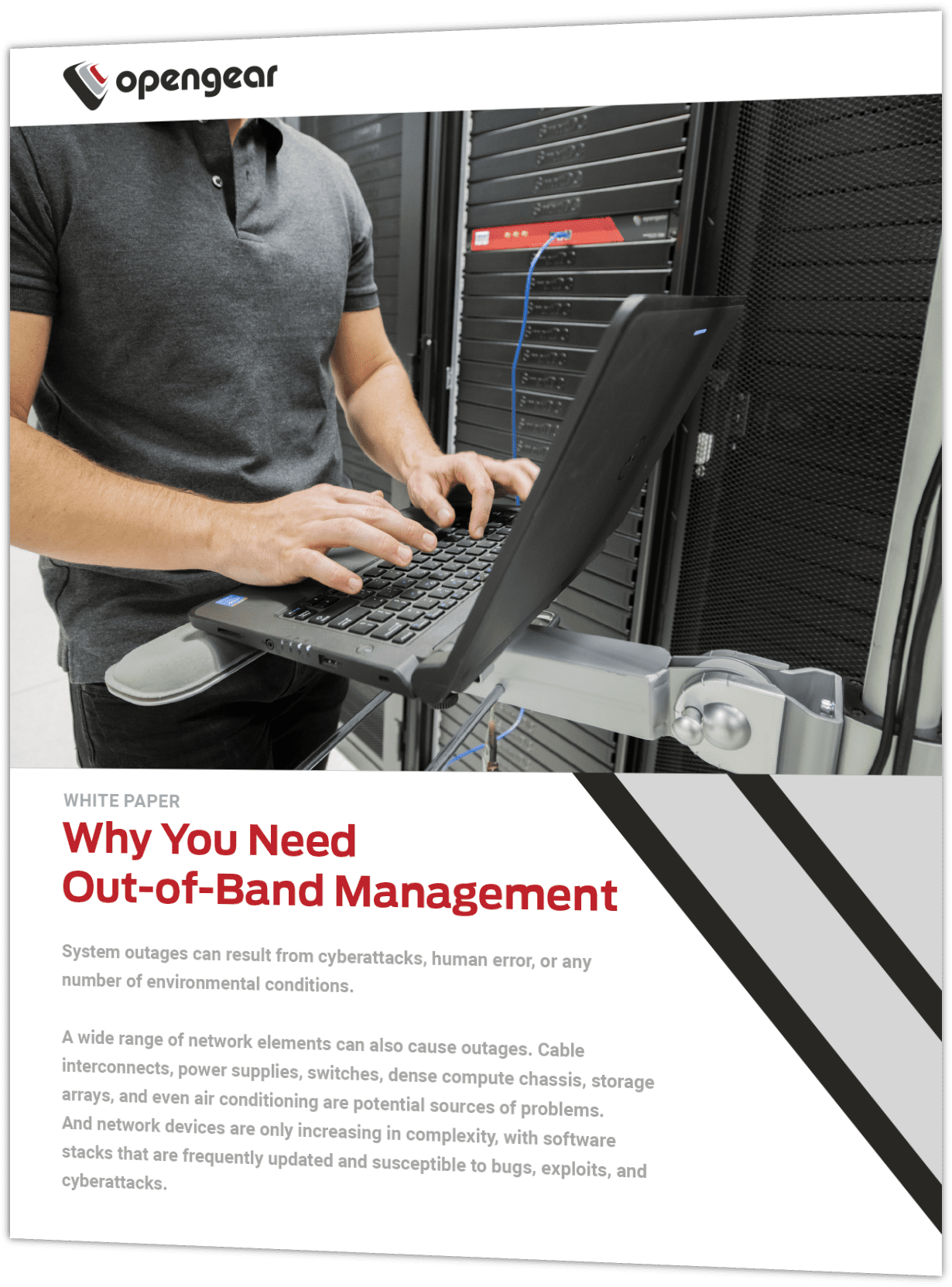
Out-of-Band management’s primary application is to provide secure, remote access to your critical resources even when the primary network is down. It offers presence and proximity to your distributed network, with a console server at every location, physically connected to routers, switches and key hardware. The addition of 4G-LTE provides a secure alternative access path, and Failover to CellularTM provides enough bandwidth for critical processes to continue to operate during an outage. When the network goes down, Out-of-Band keeps you running.
Is it smart to rely on the Production network to manage your network every day? With secure remote access to your devices via the console servers, Out-of-Band (OOB) management creates an always-on independent management plane, giving you reliable access to monitor and manage your IT infrastructure. Lock down the most critical functions on the Production network, and use the more secure OOB network to configure and manage your devices. Out-of-Band is the Network Engineer’s Network.
An investment in Out-of-Band Management is an investment that pays off every day.
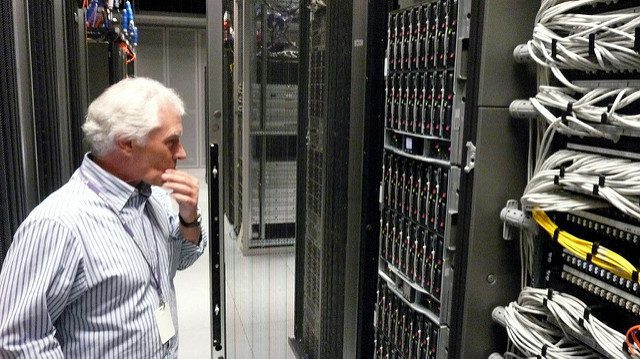
Smart OOB allows organizations across the globe to ensure resilient backup connectivity, seamlessly access devices in remote data centers and reduce costs. Opengear’s console servers and infrastructure management solutions provide resilience and dependability to improve management functions.
Learn how cloud provider Secura Hosting utilized Smart OOB to reduce the time-consuming nature of dispatching engineers to its data center sites to make configuration changes and troubleshoot issues. Having deployed Smart Out-of-Band by Opengear, they’ve improved their management capabilities which led to a return on investment in just seven months
Case Study: Secura Cloud Hosting
Your customers expect the same level of service, no matter where their data comes from. As computing moves closer to the edge of the network, the high uptime of a data center must be translated to small, remote locations. With no engineer on site, and with physical redundancy cost-prohibitive at each location, you need an alternative approach to resilience. Always-on access to an independent, secure management plane via a centralized software system provides a way to monitor and remediate issues at your edge locations without sending someone to site. Out-of-Band adds resilience to your network.
In an independent survey of 500 Global IT Leaders, 49% said that Network Resilience was their #1 Priority.
SD-WAN provides organizations with secure network connections at a lower cost. Creating more agile Wide Area Networks (WANs) that are able to support the increasingly sophisticated distribution of network devices across multiple sites, the wide range of SD-WAN benefits have made it the standard in enterprise deployments.
These benefits include:
To provide these benefits however, the local routers in SD-WAN deployments have become more sophisticated which can pose challenges to traditional network management which expects constant network connectivity.
To learn more about smart solutions necessary for SD-WAN deployments, download our white paper today!
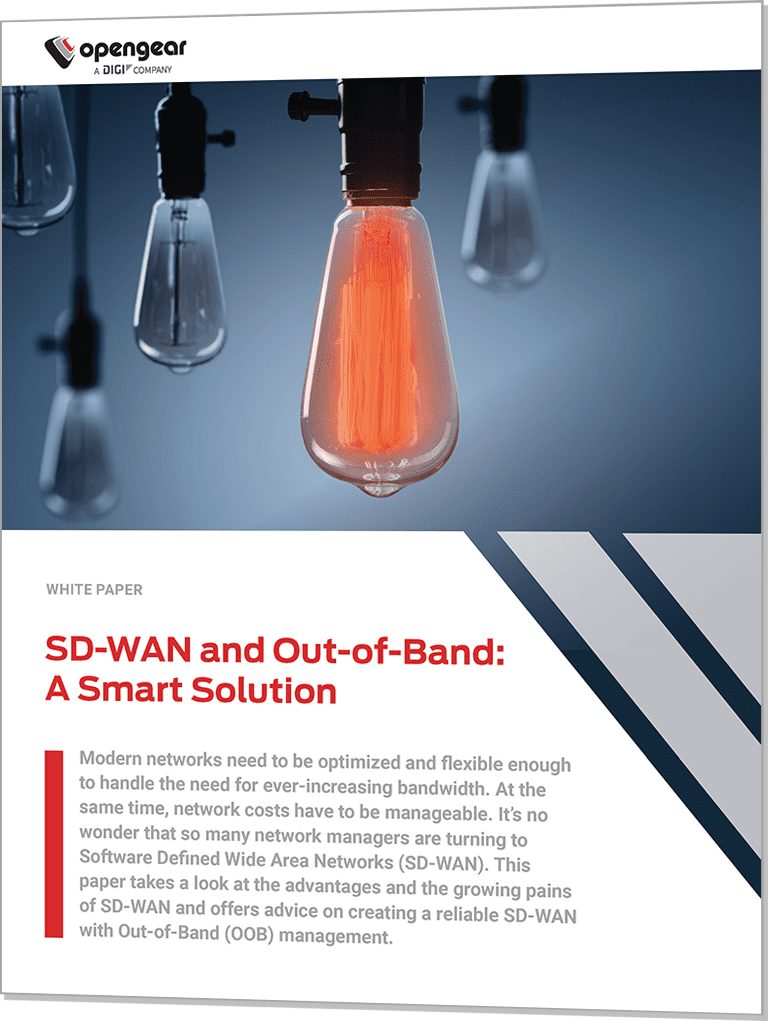
The new flexibility enabled by SD-WAN brings with it a heightened need for remote engineers to manage on-site devices. The sophistication of the SD-WAN hardware introduces points of failure which without the proper solutions in place, become large scale disruptions.
These points of failure include:
Updates: Every time a firmware update is executed, there is a risk of a misconfiguration or error which can bring down the router.
Security: SD-WAN needs additional security offerings to protect the enterprise. The primary SD-WAN connection must be secure, and must be added to any other security solution being deployed.
Read our SD-WAN Solutions Overview Sheet to learn more about possible points of failure.
SD-WAN is not a standalone solution. During the initial rollout or migration from the previous WAN, an organization’s network can be left unstable with frequent updates and glitches. Although there are many benefits to SD-WAN deployments, single points of failure can result with potential downtime. Smart Out-of-Band supports SD-WAN deployments, allowing engineers to access the network at all times.
Smart Out-of-Band is separate to the production network, providing engineers the ability to remotely monitor and manage all remote devices so that a disruption won’t affect the primary operation. Ensuring continuity and uptime using automated intelligence, Smart Out-of-Band paired with Failover to Cellular™ enables network resilience by providing always on access. Lighthouse Enterprise provides full network visibility to diagnose and remediate the issue if disruption occurs.
Learn more about the benefits of Smart Out-of-Band from Opengear for your next SD-WAN deployment!
Network labs require always on connectivity, whether supporting device testing before shipment, validating firmware upgrades or developing new hardware. Housing equipment and software from a wide range of vendors along with a growing number of IoT devices, Smart Out-of-Band management provides an ease of configurability and automation for even the most complex network lab.
To ensure that customers receive fully functioning products, extensive testing is completed before shipment. Unrealistic for one operator to efficiently run these Devices Under Test through the QA process, advanced features of Opengear console servers remediates this issue ensuring speed and high reliability for always on access. Allowing up to 96 devices to be connected at once, programming enables it to simulate operator input through a series of standard tests. Alerts, pass/fails and input/outputs are available to the QA team for final verification. Cascading allows multiple Opengear console servers to be clustered with one unit acting as the master to thousands of serial ports. These lab networks can then test large batches of devices with minimal operator intervention which enables efficient, high density testing and leads to significant cost savings.
Remote testers can:
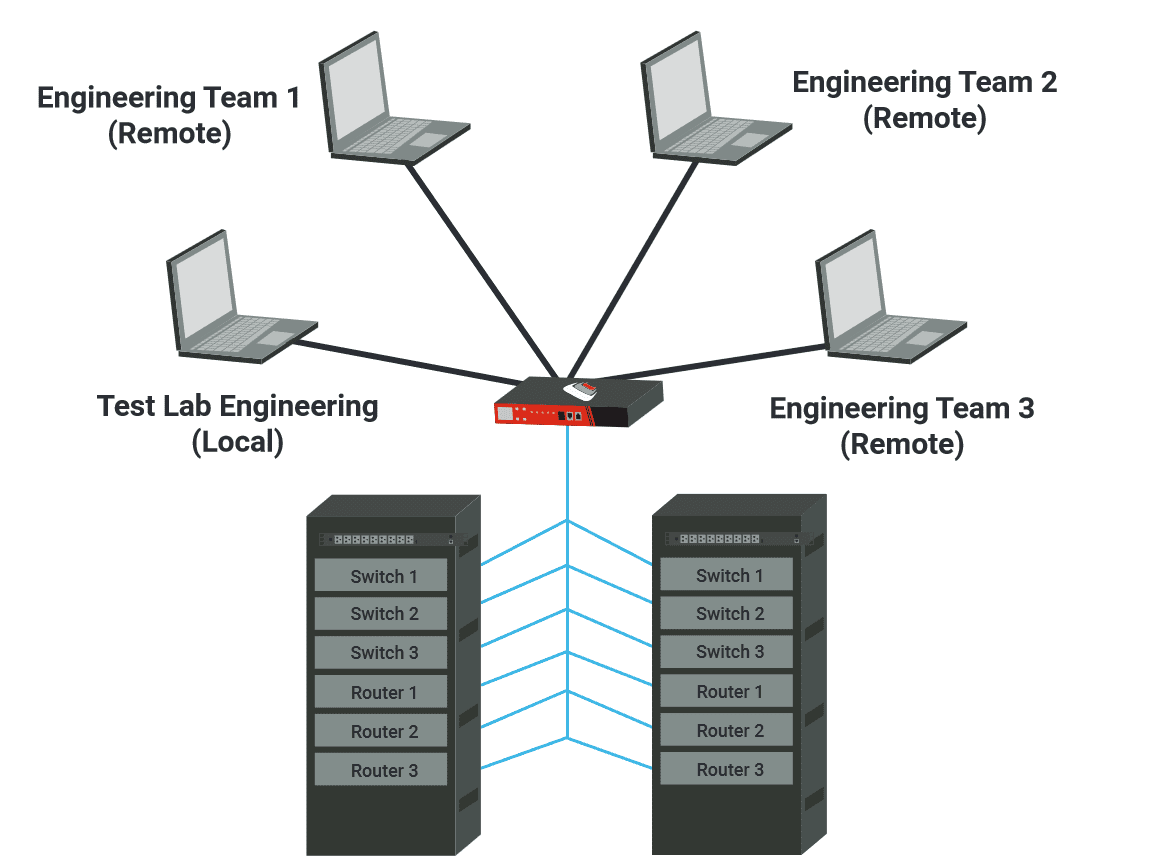
One of the most common applications for network labs is validating firmware upgrades and regression testing on various versions of operating systems. In these cases, any action or output must be logged and available for analysis – console errors, results, edge cases, random re-boots, last gasp trace and more. Opengear console servers support multiple versions of firmware with large embedded memory. There is also support for power cycling frozen test devices with preconfigured alerts while all actions and outputs are logged for analysis.
Connect to a wide range of devices with:
Zero Touch Provisioning allows lab network engineers to set up new devices with automation to enable quick deployment and configuration in new, multi-vendor environments. Paired with Smart Out-of-Band engineers are able to manage and monitor remote equipment. High port densities allow for a wide variety of configurations while multiple firmware updates are enabled with embedded memory.

In today’s hyperconnected fast-moving, and complex world, manual deployments are a thing of the past—an error-prone, time-consuming, and burdensome process that results in delays, security risks, and increased costs. To overcome these hurdles, Opengear has introduced a new advanced solution: Lighthouse Service Portal.
As part of Opengear’s hybrid cloud deployment model, the all-new Lighthouse Service Portal is a cloud-based service that simplifies and automates the initial setup of all Opengear appliances and more. The Lighthouse Service Portal (LSP) offers a zero-touch provisioning service that automates the onboarding of Opengear appliances into Lighthouse.
Customers can then leverage configuration management tools and API integrations to push configurations through the Lighthouse Smart Management Fabric and Connected Resource Gateway, completing the provisioning of Opengear appliances and connected network resources.
Manual provisioning methods require logging into a single unit via CLI or Web/Node UI, or low-touch provisioning that requires a USB stick and sending a deployment team to each location. This leads to configuration delays and drift—Opengear’s new cloud-based service delivers secure and streamlined zero-touch provisioning.

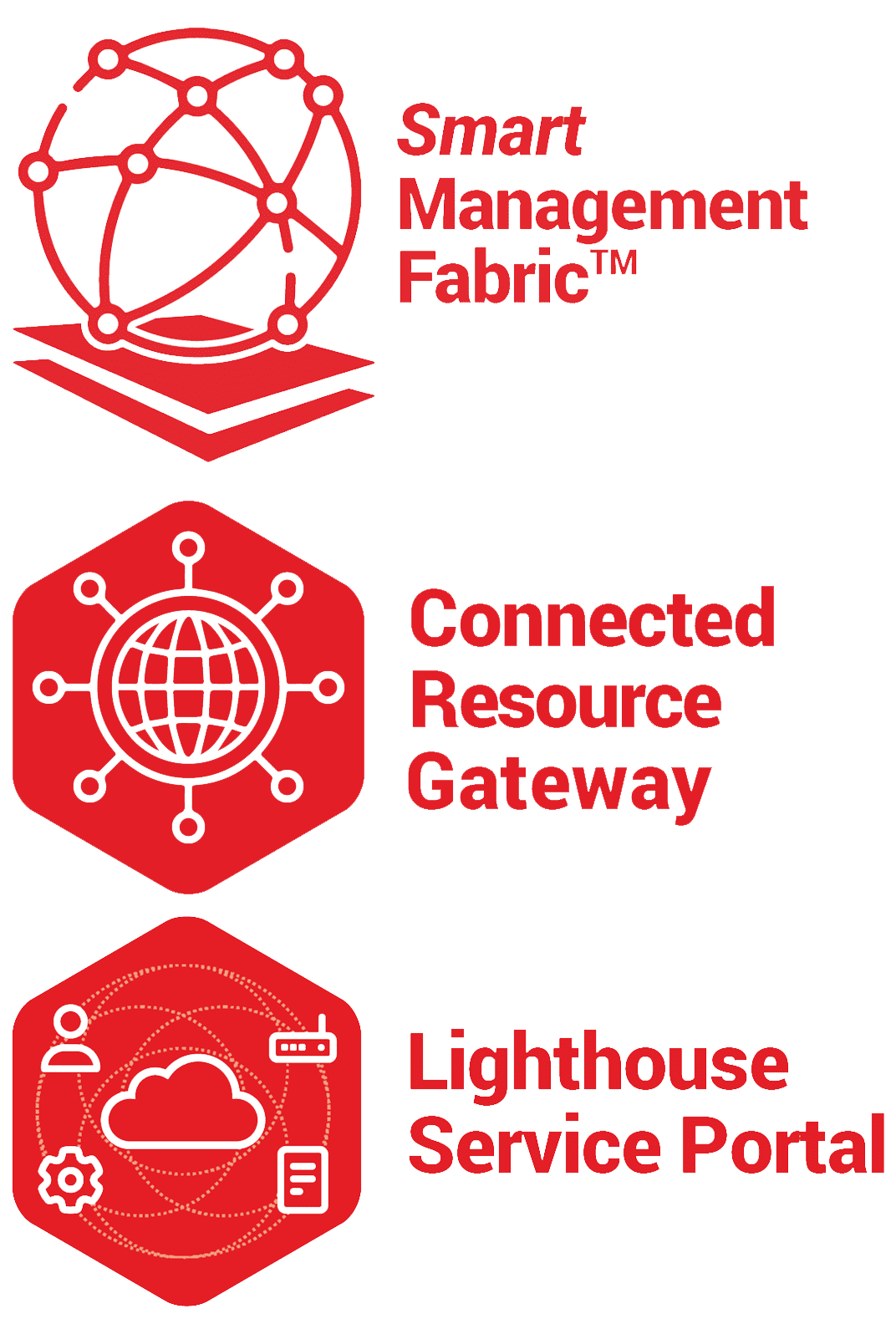
Enhance your deployments with the cloud-based Lighthouse Service Portal, which seamlessly integrates with Opengear’s solution. Whether deployed on-premises or in the cloud, Lighthouse used in conjunction with Lighthouse Service Portal simplifies and streamlines the initial setup of your Opengear appliances, ensuring a smoother and more efficient Day 0/1 experience.
A multinational technology company, an Opengear customer, with data centers and offices around the globe, was preparing to deploy and provision IT infrastructure in new data centers. As part of this project, they aimed to install Opengear appliances across multiple rows of equipment in these new facilities.
Initially, they opted for the low-touch deployment model, which involved hiring IT experts, coordinating their schedules, and sending them to the data center with a config file on a USB stick.
However, they soon realized this approach was inefficient and costly due to the scale of the project. Managing the third-party engineers’ schedules was challenging and paying setup fees for each appliance deployment was cost prohibitive. Since this wasn’t a true end-to-end method, it didn’t allow them to maintain security throughout the entire provisioning process.
As a beta user of the Lighthouse Service Portal, this global IT organization decided to utilize our new cloud-based service for their large deployment project. The results were immediate, with significant cost savings of thousands of dollars, many hours of full-time employee project management saved, and the elimination of security risks with end-to-end zero-touch provisioning.
Opengear Failover to Cellular™ (F2C) provides continued internet connectivity for remote LANs and equipment over high-speed 5G LTE or 4G LTE networks when the primary link is unavailable. Ensuring enhanced bandwidth, and lower latency and improved remote network management to keep the network running smoothly and link diversity for true WAN resilience, Failover to Cellular is built on robust IP Passthrough technology. This allows for easy integration into existing installs or can be rapidly deployed for instant-on connectivity for new networks and branch locations. This feature is useful for an SD-WAN deployment. SD-WAN enables organizations to reduce costs and maintain secure network connections, however the high bandwidth internet connections, routers and constant firmware updates associated with this can introduce a single point of failure. If the network goes down during a deployment, Smart OOB™ and Failover to Cellular ensures secondary access to the routers to easily reflash or power cycle. NetOps staff are able to remotely get the network backup and running without an onsite visit. READ CASE STUDY
Failover to Cellular allows organizations to maintain connectivity and decrease disruption with ensured business continuity. Easily integrating with existing IT systems and network infrastructure, F2C restores WAN connectivity without manual intervention. Utilized with Smart Out-of-Band (Smart OOB), which is built into all Opengear devices, organizations are able to have remote access even when WAN and LAN networks are down. During an outage, in order to remediate the problem as quickly as possible, network engineers must have visibility of the whole network. Smart OOB provides engineers with full visibility to maximize uptime and reduce outages. SCHEDULE A DEMO
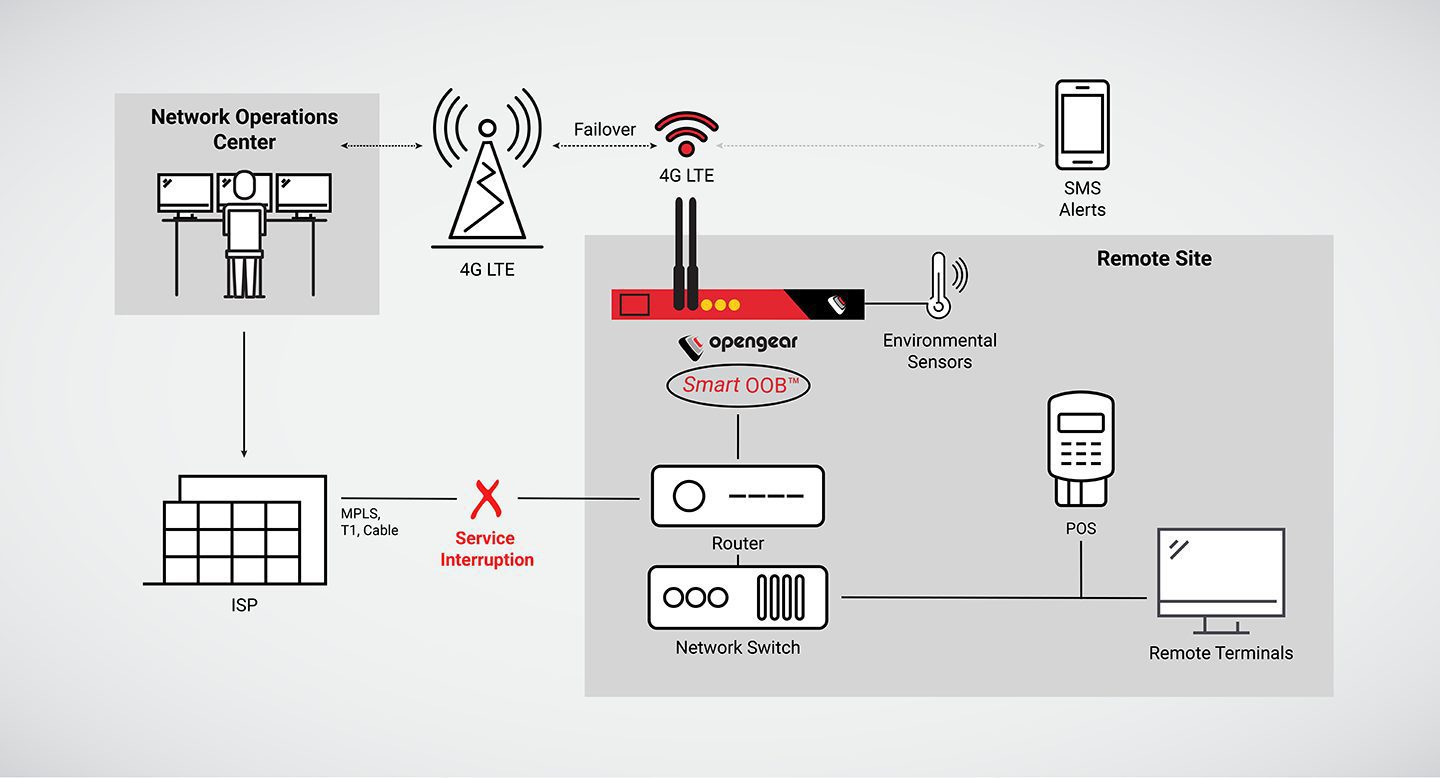
Distributed enterprises often times may experience disruption events that effect the primary network connection. Failover to Cellular built-in to Opengear devices, automatically activate a secondary connection to re-establish in and outbound network access. Once failover is enabled, Opengear devices are able to detect failures sending ICMP ping requests from the primary network interface to a primary and secondary probe address remotely. If these requests fail – the primary connection has been deemed as having also failed. When the primary connection has been restored, the devices automatically fail forward and resumes normal operation. READ BLOG
Data center environments continue to evolve, with their role and composition having changed significantly over the past two decades. From hyperscale data centers to colocations, whatever type of facility it is, enterprises expect speed, performance and efficiency.
The increase of new technologies such as the Internet of Things (IoT) are a major driver of growth in the data center market. The US Data Center market is projected to reach revenues of more than $60 billion by 2024, the high demand for facilities, now more than ever, require a smart solution for monitoring data center equipment.
To learn how resilient your data center is, download our ebook!

Smart Out-of-Band by Opengear raises infrastructure management to a new level. Extending beyond traditional out-of-band management solutions, it ensures efficient, secure access to data center infrastructure.
Streamlining remote management of network infrastructure, Smart Out-of-Band provides an alternative path to devices when the primary network is down. Automated intelligence ensures uptime for critical applications by enabling remote monitoring and control of the environment. Proactive identification allows enterprises to quickly remediate issues to ensure business continuity and minimize downtime costs.
Read our white paper to learn more about the benefits of Opengear smart solutions.
Smart Out-of-Band allows organizations across the globe to ensure resilient backup connectivity across devices in distributed data centers. Opengear’s console servers and infrastructure management solutions ensure network resilience to enable business continuity.
Opengear worked with i3D.Net, a leading provider of high-performance hosting and global infrastructure services, to help maintain its global operation. Requiring the network to be constantly up and running, they deployed Opengear solutions to ensure resilience to its routers all across the world.
Watch our video to learn how i3D.net experiences maximum uptime with Opengear.
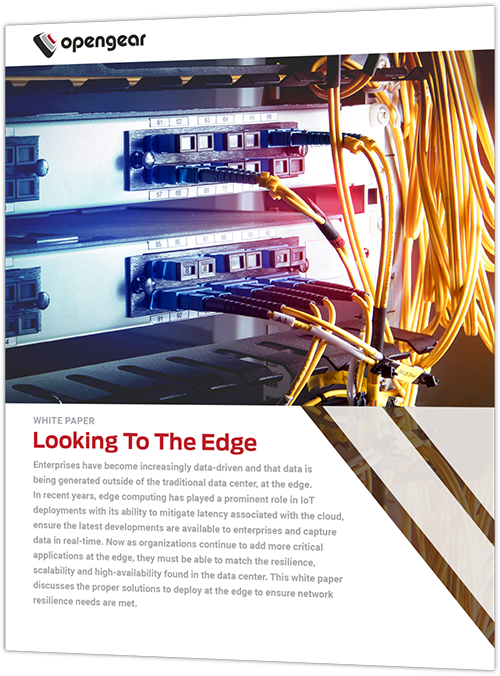
A shift is occurring at the edge, with enterprises prioritizing network infrastructure at remote sites. As IoT deployments increase, organizations are becoming more reliant upon data generated outside of the traditional data center.
To meet constantly growing demands, organizations are adding more critical applications at the edge with market growth expected to reach $249.06 Billion by 2030. As this occurs, enterprises must be able to match the resilience, scalability, and high-availability found in the data center with a smart solution.
To learn more about evolving needs at the edge, download our white paper!
Smart Out-of-Band (Smart OOB™) paired with Failover to Cellular™ enables enterprises to ensure resilient backup connectivity to remote networks. Providing access to infrastructure during disruptions, organizations are able to ensure business continuity and uptime for critical applications.
Smart Out-of-Band adds intelligence to the edge, allowing enterprises to manage infrastructure at multiple sites. Designed to exceed the needs of IT and IoT resilience, it enables advanced capabilities for automatic responses for identification and remediation at the network edge.
Failover to Cellular ensures uninterrupted availability for remote networks with 4G LTE. Built on robust IP Passthrough technology, it is easily integrated into existing installs or can be rapidly deployed for instant-on connectivity for new networks and branch locations.
Lighthouse Enterprise serves as a central hub for remote sites, providing a clear view across the network. By reducing human error and guaranteeing repeatability, organizations reduce the chance of small network events becoming large scale disruptions.
Watch our video to learn more about Smart Out-of-Band.
Smart Out-of-Band and Failover to Cellular enable organizations to remotely remediate issues without interrupting business operations when the primary network is down.
Opengear worked with ePlus, a leading global provider of integrated technology services and solutions to ensure reliable connectivity at its remote sites. Opengear solutions have been deployed at its branch offices in the US for remote access, maintenance, and proactive monitoring.
Read our case study to learn how ePlus ensures uptime with Opengear.
Redundancy helps — but it isn’t enough. Today’s networks require intelligence, automation, and embedded protection to ensure business continuity.
The Opengear Network Resilience Platform delivers exactly that — combining:
So your team can monitor, manage, and recover your network — on the first day, the worst day, and every day.

Gain continuous visibility and control over your critical infrastructure — even when the primary network is down. Stay ahead of outages with always-available Smart Out of Band™ access.

Accelerate rollouts and streamline operations with built-in NetOps automation — so you can deploy, manage, and scale resilient infrastructure faster and with greater consistency.

Enjoy predictable resilience — with 5-Year Hardware Warranty and required Foundation or Premium Supportproviding lifecycle-aligned protection and simplified renewals.
The Opengear Network Resilience Platform brings together the critical capabilities that today’s infrastructure teams rely on — all built into a unified, integrated solution.
At its core:
Smart Out of Band™ Management: Maintain remote access and visibility during outages with Opengear console servers.
Automated Provisioning and Configuration: Securely deploy and manage infrastructure at scale with built-in automation tools.
Lighthouse® Management Software: Centrally manage every Opengear device across your global infrastructure — securely and consistently.
Built-In Value: Every deployment delivers built-in value — resilient hardware, centralized management, automation, and integrated Foundation or Premium Support — all as part of a unified platform.
Whether you’re rolling out new sites or managing thousands of devices, Opengear makes it easier to scale smartly and support confidently.

Explore how Opengear’s integrated platform — with embedded protection and guaranteed support — helps you keep critical services running.

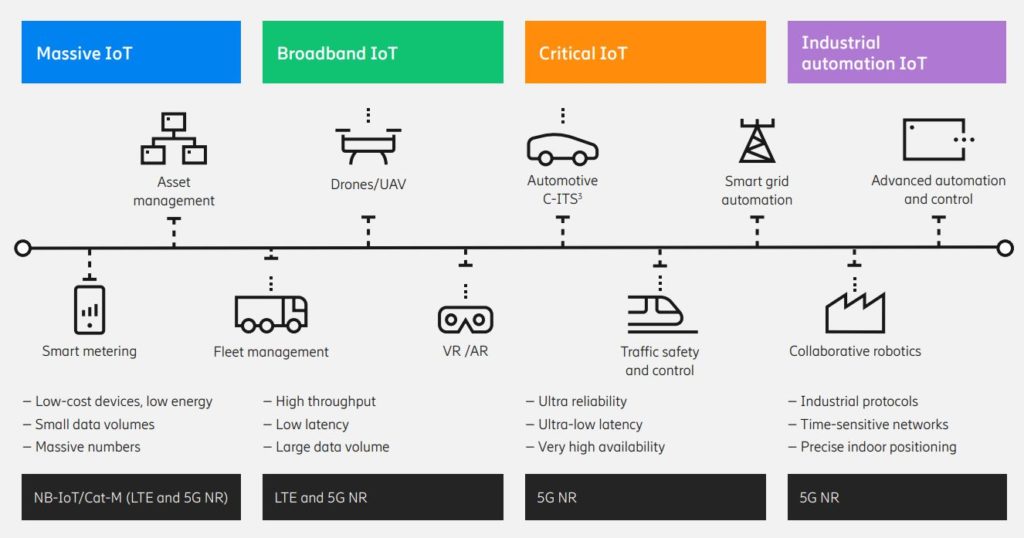 Cellular IoT use case segments
 Case Study: