What It’s Actually Like When Your Network Goes Down at 4am
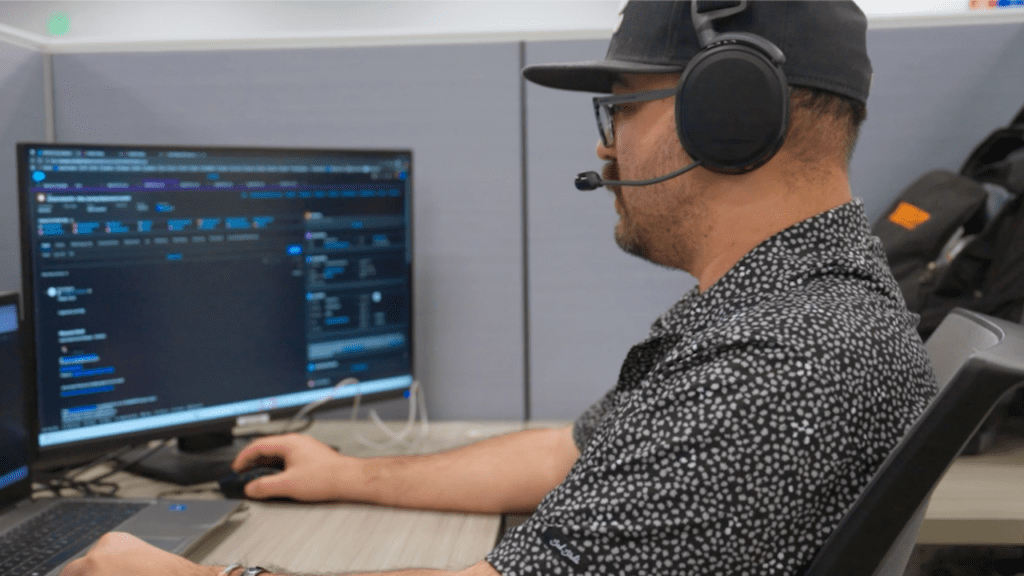
Carl Lundgren is a Principal Technical Support Engineer at Opengear. He spends his days, and occasionally his nights, helping network engineers regain access to infrastructure they can no longer reach. It is, by his own description, a job that requires patience, a working knowledge of cellular failover protocols, and a tolerance for situations where the person on the other end of the phone is not having a good time.
He has troubleshot enough unusual configurations to know that the outages that look simple on the surface often aren’t. Most of the time, the problem requires extra digging. He keeps a mental list of questions worth asking early: What changed recently? What does the customer actually have access to right now? Is this affecting one device or many? “You’re not just fixing a problem,” he says. “You’re figuring out what the problem actually is first. Those are two different things.”
When something unusual comes in, it doesn’t sit in a queue. The team works directly with engineering and product, something Carl says has changed significantly from how support used to work. “We used to operate in silos,” he says. “Today, communication is probably the biggest key to a lot of recent successes. We’re not problem-solving in isolation.”
_____________________________________________________
Taylor Blodgett, Tech Support Specialist, describes the beginning of a support call the way a doctor might describe intake: Gather information before drawing conclusions. “Listen to the customer when they call in,” he says. “Get full information as you’re talking to them, and then you can appropriately respond with answers and solutions.”
He has learned to ask questions carefully, in the right order. He has also learned that when a network is down and a customer’s boss is asking questions, what they need most is someone who sounds like they’ve seen this before and knows what to do next.
The issues that come in range from quick configuration questions to full network outages where the customer has lost visibility into their entire infrastructure. Some tickets resolve quickly. Some don’t. Taylor’s job is to triage fast, communicate clearly, and escalate when the situation calls for it. “If something escalates, we jump right on it,” Taylor says. It also helps that the team isn’t a big call center. They know the people they’re working next to and can call each other for help.
Taylor notes what gets heard on support calls doesn’t stay in a queue; it feeds directly back into the product. Patterns in tickets, configurations that keep causing trouble, and features customers keep asking for all find their way to engineering, meaning the people closest to customers are often the ones quietly shaping what gets built next.
He also thinks about security in a way that customers sometimes don’t, at least not until something goes wrong. When a network goes down, the instinct is to restore access as quickly as possible. But how you restore it matters. “You don’t want to recover from one problem and create three more,” he says. Opengear’s Smart Out of Band management provides cellular connectivity that keeps access secure during an outage, so support engineers aren’t helping customers punch holes in their own infrastructure to get back online. “It gives the company access to their entire network over cellular,” he says, describing what happens when a primary network fails. “If their ISP is having an outage or their building is down, their only access is that cellular connection through our devices.”
____________________________________________________
Jacob Jeo, Senior Support Engineer, does not like to end a call before the problem is resolved. This has occasionally made for long calls, and uncommon working hours. Outages do not schedule themselves around business hours, and customers who are dealing with a critical incident at midnight are not well-served by a voicemail. “Sometimes we have calls that last a few hours,” he says, without particular drama. “We are not going to just leave our customers to figure it out.”
Jacob joined Opengear with a background in networking and has spent his time on the support team accumulating a catalog of scenarios that would make most IT professionals uneasy to read. Devices that lost contact with their management plane during a firmware update. Sites that went dark because of an upstream provider failure that nobody on the customer’s team knew about yet. Configurations that worked fine for years and then, for reasons requiring real investigation to uncover, stopped working.
What makes extended troubleshooting sessions manageable is Smart Out of Band access. “It sounds like a small thing until you need it,” Jacob says. With that remote access, the support team is ready to move fast.
The target: 15 minutes. “We’re trying to get at least a response to let you know we’ve got your ticket, we’re working on it, and we’re going to help you out, within 15 minutes of when tickets are submitted,” Jacob says.
___________________________________________________________
All three of them use AI-assisted tools for ticket triage and knowledge searches. None of them trust it unconditionally.
“It gets you in the ballpark very quickly,” Carl says. “But you can’t just blindly trust the first answer it gives you. We can trust but we need to validate.”
Taylor agrees. He’s seen AI provide wrong answers confidently, but adds the tools are most useful for surfacing similar past cases quickly, which saves time at the beginning of an investigation. Jacob says he thinks of it like autocomplete. Useful, not authoritative. “It’s nice that we can use AI to search through case history to find similar issues and help figure out the root cause, but it’s still up to us to make sure the solution works.”
The value of the tools is speed, not judgment. A support engineer who can pull up five relevant past cases in 30 seconds is better positioned than one who has to dig through documentation manually. But the actual diagnosis still comes from a person who understands what they’re looking at.
____________________________________________________________
The honest version of what Opengear support does is this: People call when something is broken and they need help. The engineers pick up, ask questions, dig in, and stay until it’s fixed. Most of the time the hardware has already been doing its job quietly for months or years. The call comes during that one percent of the time when something upstream has failed and the out-of-band path is the last one standing.
That is, more or less, the whole job.
Opengear offers Foundation and Premium support plans to match your infrastructure and risk tolerance. Foundation Support covers 8×5 regional access. Premium Support adds 24×7 global coverage and priority escalation when the network goes down. Schedule a demo to see how it works before you need it.