opengear
SECURE REMOTE ACCESS OF YOUR CRITICAL NETWORK RESOURCES
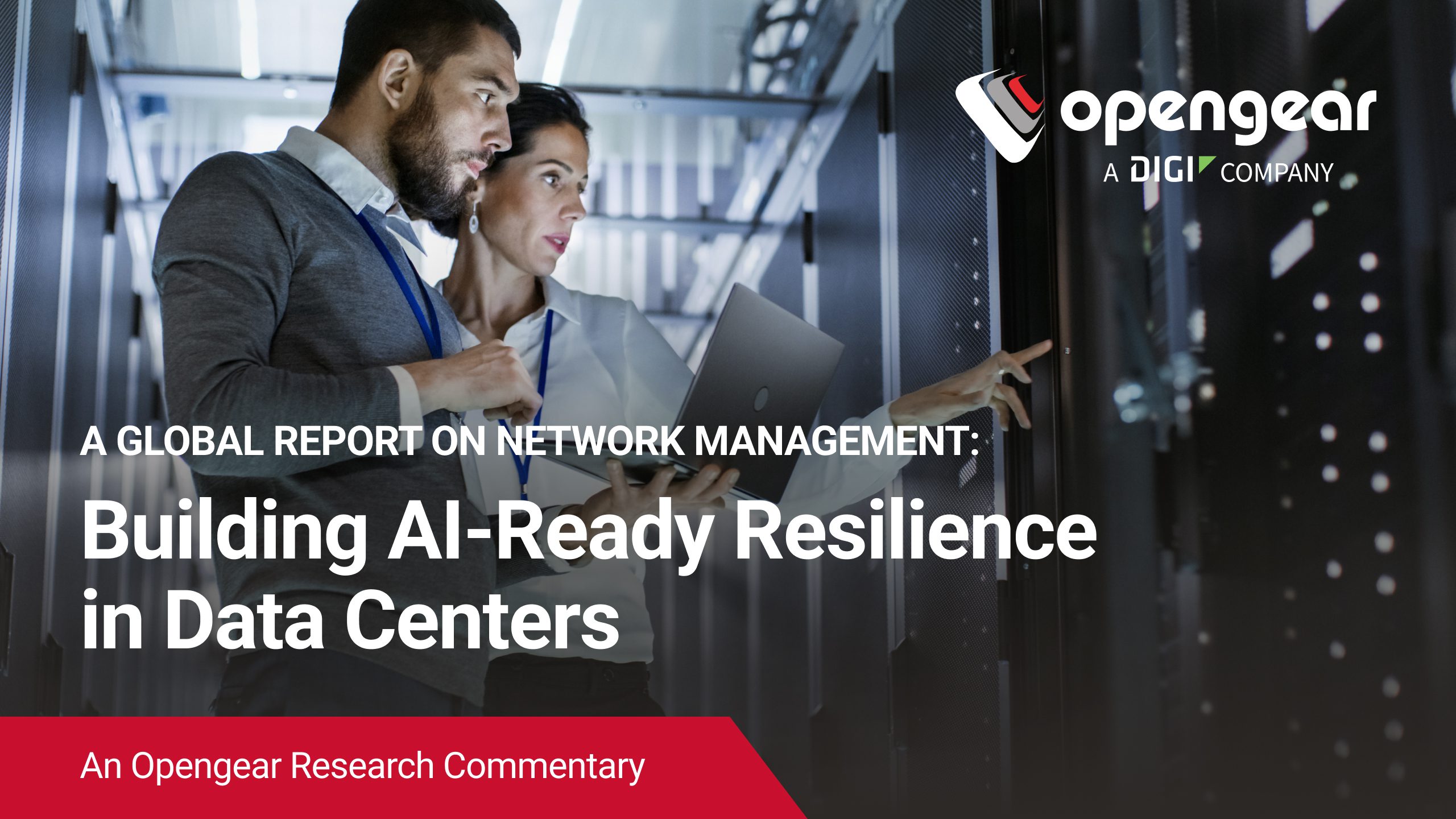
Data centers are the backbone of today’s digital economy. As businesses expand their services and rely more heavily on connected infrastructure, the performance, security, and resilience of networks are mission-critical.
Opengear’s latest research report reveals an urgent reality: network outages are happening more often, causing greater disruption, and costing organizations millions.
This global study surveyed more than 1,000 CIOs, CSOs, and network engineers across the United States, United Kingdom, France, Germany, and Australia to understand how IT leaders are addressing risk, investing in resilience, and adapting to increasingly hybrid and distributed infrastructure.
Here’s what we learned.
84% of IT leaders reported an increase in network outages over the past two years.
The financial impact is significant. Nearly one in three organizations reported losses of between $1 million and $5 million due to outages in the past year. Beyond the money, outages damaged reputations, disrupted operations, and eroded customer trust.
Takeaway: Outages are now regular business risks with major consequences for revenue and brand equity.
The survey revealed both technical failures and human error.
As enterprises manage hybrid IT environments that span centralized data centers, edge locations, and cloud services, the chances of disruption grow and recovery becomes more complex.
Takeaway: Outages often stem from preventable issues, but complexity magnifies their impact.
To reduce these risks, organizations are making targeted investments.
Together, these approaches strengthen infrastructure resilience:
Takeaway: AI, edge, and OOB form a resilient foundation for always-on operations.
Security risks are also growing as networks expand.
In response, IT teams are turning to:
Out of Band management plays a role here as well, providing visibility and control even when the production network is compromised.
Takeaway: Security and resilience are inseparable. Distributed networks demand both.
The findings are clear: outages are increasing, infrastructure is more complex, and the cost of failure is rising.
Forward-looking organizations are responding by:
Patrick Quirk, President and General Manager of Opengear, explains:
“Outages are no longer isolated events. They are happening more often, and the cost is hitting businesses hard. Complexity, aging infrastructure, human error, and cyber-attacks are all part of the problem. As organizations lean more heavily on data centers to power digital transformation, the stakes are higher than ever. An outage is not just downtime. It is lost revenue, lost productivity, and lost trust.”
Opengear’s research confirms what IT leaders already know: resilient infrastructure is no longer optional. It is the foundation of digital business, ensuring uptime, security, and continuity even as networks grow more distributed and complex.
From AI-driven automation that predicts and prevents failures, to edge computing strategies that reduce latency and avoid single points of failure, to secure Out of Band management that provides always-available remote access, the next generation of data center and network infrastructure is being built with resilience at its core.
Resilience is not an afterthought or a bolt-on. It is becoming a design principle that organizations are embedding into every deployment from the start.
Learn more: Download the full research report for complete findings and recommendations.
What causes most data center outages?
Opengear’s research shows the leading causes are device configuration changes (27%) and server hardware failures (26%), followed by power supply issues, cyberattacks, and software upgrades.
How much do network outages cost businesses?
Nearly one in three organizations reported financial losses between $1 million and $5 million in the past year, with additional costs tied to reputational damage and customer trust.
Why are network outages increasing?
Outages are increasing because IT environments are more complex and distributed, spanning data centers, edge sites, and cloud services, which creates more opportunities for failure.
What is Out of Band (OOB) management?
Opengear’s Out of Band management, also known as Smart Out of Band, is a secure, independent management channel that gives IT teams remote access and control of infrastructure even when the primary network is down.
How does Out of Band management improve resilience?
OOB management ensures uptime by allowing IT teams to diagnose, access, and restore systems remotely, reducing downtime during outages or cyber incidents.
How do AI and edge computing help prevent outages?
AI and machine learning predict and prevent failures through automation, while edge computing reduces latency and avoids single points of failure by distributing workloads closer to users.
Why is security a growing concern for data centers?
As organizations adopt cloud and edge strategies, the attack surface expands. Risks such as data breaches, insecure APIs, and compliance challenges require solutions like OOB management, which adds secure visibility and control even during an attack.
SANDY, UT, (January 30, 2025) — According to new research by Opengear, a Digi International company (NASDAQ, DGII, www.digi.com), 57% of network engineers expect their organizations’ investment in AI for network management to increase by more than 25% over the next 2 to 3 years. And 49% of CIOs (Chief Information Officers) and CSOs (Chief Security Officers) agree. Yet, 70% of engineers believe the expected increase in investment is not fully sufficient to meet business goals.
The survey, which polled over 1,000 CIOs, CSOs, and network engineers across the UK, US, France, Germany, and Australia, explores the perspectives of leadership and technical teams regarding AI in network management and cybersecurity. While both groups recognize AI’s potential, differences arise around how to address barriers and priorities for implementation.
When it comes to adopting AI, network engineers see high initial investment costs (29%) as the biggest barrier holding their organization back from fully implementing it for network management, while CIOs and CSOs rank it below regulatory and compliance issues (cited by 36%) and lack of skilled personnel to manage AI systems (30%).
In addition to the differing concerns about how to manage resources for successful AI integration, there is also a discrepancy in how each group is preparing for AI. Senior leaders are prioritizing continuous monitoring and real-time analytics (32%), while network engineers believe the focus should be on training and development for IT staff (31%) and enhancing network resilience (26%).
The survey also highlights AI’s role in cybersecurity. Two thirds (66%) of CIOs and CSOs have allocated only 4% to 10% of their IT and cybersecurity budget to AI for network management in the last financial year. But this is where network engineers see AI having a significant impact, with 69% believing that integrating AI will improve their organization’s ability to respond to cybersecurity incidents.
“The research pinpoints a difference in focus between the C-suite and network engineers, shaped by their respective roles and where they are in their AI implementation journey,” said Patrick Quirk, SVP and General Manager, Opengear. “Leadership and technical teams naturally see risk differently, which leads to varying priorities within a shared vision. The findings clearly demonstrate a shared recognition of AI’s transformative potential.”
Quirk added, “AI can revolutionize network and risk management. However, ensuring collaboration among senior leadership is crucial to effectively align their investments. By bringing the C-suite and network engineering perspectives together, businesses can create a unified strategy that supports AI-driven innovation and business goals.”
Differences in perspective extend to AI leadership. The CIO is ultimately responsible for the rollout of AI in network management, say 29% of senior leaders, followed by the CSO (19%). Network engineers, however, believe the CSO should take the lead (22%), reflecting their emphasis on security expertise.
To obtain the full report or discuss how to implement the optimal AI strategy for your organization’s network management needs, contact Opengear.
About Opengear
Opengear, a Digi International company, delivers secure, resilient access and automation to support critical IT infrastructure on the First Day, Worst Day, and Every Day. Through presence and proximity, Opengear solutions enable provisioning, orchestration, and remote management of network devices through innovative software and appliances. Opengear solutions are trusted by global organizations across financial, digital communications, retail, and manufacturing sectors. The company is headquartered in Utah, with an R&D center in Brisbane, Australia. For more information, visit www.opengear.com.
About Digi International
Digi International (NASDAQ: DGII) is a leading global provider of business and mission-critical Internet of Things (IoT) connectivity products and solutions. We help our customers create next-generation connected products and solutions to deploy, monitor, and manage critical communications infrastructures and compliance standards in demanding environments with high levels of security, relentless reliability, and bulletproof performance. Founded in 1985, the company has helped customers connect more than 100 million things — and counting. For more information, visit www.digi.com, or call 877-912-3444 (U.S.) or 952-912-3444 (International).
Learn how one of the top performing banks in the United States utilized Opengear smart solutions to decrease their downtime, reduce the need for site visits, and ensure compliance requirements are met.
To learn more about network resilience solutions for your organization schedule a demo today!
Network Resilience: Keeping the network running at the core and out to the edge of the infrastructure, with no disruption to the customer experience in the event of human error, external issues or hardware failures.
Network outages have a direct impact on an organization’s revenue, customer retention and brand. Network resilience plays an important role in ensuring business continuity. When the network is down, money can be lost, productivity can be stunted and data security can be at risk.
Achieve true network resilience, when an organization is able to maintain services, remove points of failure and has an understanding of how to bring the network back up during a disruption.
Ensuring network resilience is an important business priority for i3D.net. To maintain its global operation, i3D.net runs a complex low-latency network, with thousands of servers spread over more than 35 points of presence on 6 continents.
It is key that this network is kept up and running at all times. As Rick Sloot, chief operations officer, i3D.net explains: “Ten years ago, this was very difficult to achieve. There were very few ways of handling and managing your servers when the internet went down and those that were available were expensive and did not work well. As technology has advanced over the past decade, customer expectations have grown in line, and a high level of network resilience is now demanded by our users.”
“As we expanded as a business, opening up new locations around the world, it was becoming increasingly difficult to find a vendor capable of delivering a reliable way of keeping us up and running at all times, across all our locations.” continued Sloot.
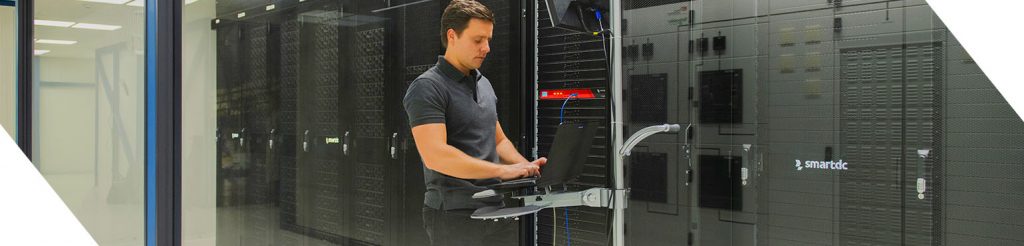
“We struggled to find local vendors who could support us. Often, we weren’t able to pinpoint the issue or access the faulty equipment. We needed to find a way of managing equipment remotely, identifying and resolving the problem, while keeping the network online. “We started to look for a vendor who could work with cellular technologies such as 4G and who could deliver out-of-band management. Opengear fitted the bill perfectly. Opengear’s tools can support 4G cellular out-of-band connections in all our global locations which have enabled us to save time and money. We were looking for a partner that could deliver triple-A equipment on time all over the globe and knew we could rely on Opengear for this.”
i3D.net decided to work in partnership with Opengear and implement its ACM 7008-2-L Resilience Gateway to provide smart out-of-band management to its entire IT infrastructure, and also to provide a built-in backup LAN and/ or backup Internet connectivity option for all their remote sites.
Today, i3D.net uses the Opengear Resilience Gateway as a fall-back, providing out-of-band management, as and when required, to its routers all over the world. It has achieved a raft of benefits as a result. For example, it has helped to significantly streamline the process of bringing new sites online.
In the past, when i3D.net had to carry out a deployment outside the Netherlands, a technical operations engineer flew to the location and installed the new switches but would typically struggle to configure them. Today, i3D.net simply connects the Opengear Resilience Gateways to these network switches and its network operations engineers back in the Netherlands are then able to configure the whole site remotely via the Opengear device. “This is very powerful and a huge benefit for us in terms of the time and costs saved not only in provisioning but also ongoing maintenance” commented Sloot.
“We were looking for a partner that could deliver triple-A equipment on time all over the globe and knew we could rely on Opengear for this.”
Using Opengear Resilience Gateways also allows i3D.net to stay one step ahead of any pending network failures. According to Sloot: “We don’t like downtime and neither do our customers. Today, if there is an issue, we can directly connect to our routers anywhere in the world without having to wait for someone at the locations to access and fix it. The agility of the Opengear solutions means we can quickly help our customers and maintain our high standards as a performance hosting company.”
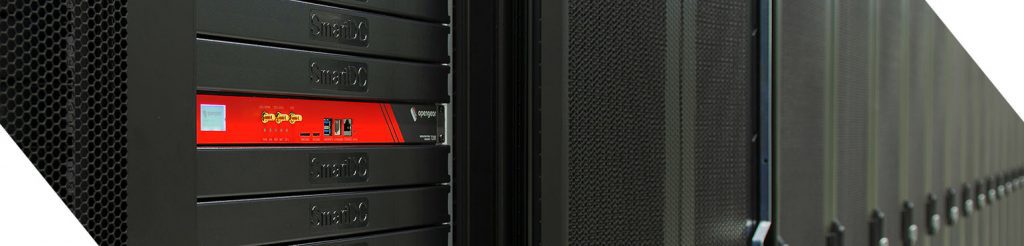
Today, i3D.net continues to expand and open global locations dynamically. It is also in the process of switching to a new Juniper Networks router platform. As Sloot explains: “This will give us the opportunity to launch our Global Low-latency Anti-DDoS solution (GLAD). Every region where we are changing the router and do not have an Opengear Resilience Gateway will now receive one.
“Finally, we have an enterprise customer for which we are remotely managing servers, running routers and firewalls in their own environment. We are planning to place the Opengear solution there. It marks the first time we have carried out a deployment of Opengear’s Resilience Gateway outside our own data centres.”
The rapidly expanding use of Opengear at i3D.net bears witness to the broad benefits it brings the hosting provider and also highlights a partnership that goes from strength to strength today and will look to evolve further in the future. i3D.net is on a fast growth path and Opengear continues to support its dynamic expansion worldwide.

Hosting Company
i3D.net is a leading provider of high-performance hosting and global infrastructure services. The company notably excels in-game hosting and infrastructure, serving 100 million gamers daily for game publishers and independent developers on consoles, PC and mobile. The i3D.net network is one of the world’s top-10 most connected hosting provider networks. i3D.net is now a Ubisoft company, having been bought by the French publisher in 2018.
One of the largest data breaches ever occurred to one of the largest financial corporations in the country, Capital One. Over the span of two days, more than 100 million Capital One credit card applications were accessed.
The hack occurred in March, however it took months before Capital One was aware of the event. The suspect is Paige Thompson, a 33 year old, former software engineer from Amazon Web Services. By exploiting a misconfigured web application firewall, she was able to access the Amazon server hosting Capital One’s customer information. After hacking into the organization’s server, it wasn’t until July 17, that a tipster informed Capital One of the existence of the stolen information.1 Thompson gained access to credit scores, balances and addresses, along with:
Finance is one of the top targeted industries when it comes to cyber-attacks. These types of institutions have a steady stream of sensitive customer information being entered into their databases making them an ideal target for hackers. Letitia James, General Attorney of New York was asked about the Capital One breach and stated, “It has become far too commonplace that financial institutions are susceptible to hacks, which raises questions like, why are these breaches occurring? Are companies doing enough to prevent future data breaches?
Just last year, more than 2 billion people were affected by data breaches and over the past decade some of the largest attacks have occurred with well known financial organizations such as JP Morgan Chase, Equifax and Citi Financial.2
Not only do these cyber attacks pose as a danger to customers, it also threatens the stability of a network. Downtime causes:
Lost Opportunities
Banks depend on the network for a multitude of reasons such as making transactions, transferring funds or processing applications. Not being able to complete such actions can lead to loss of customers and revenue.
Non-Compliance Fines
Highly regulated industries such as finance, have a large number of regulations to comply with in regards to global privacy, data and security. Any type of network downtime can cause non-compliance and result with million dollar fines.
Many times, these types of disruptions occur in a remote branch, where without the proper solutions, network engineers don’t have the ability to quickly diagnose and remediate the issue. During a cyber attack, visibility is a necessity.
Opengear devices extend your reach, providing full visibility to remote sites. Smart Out-of-Band and Failover to Cellular™ enable engineers to securely access the network and continue to run applications needed to ensure business continuity while the issue is diagnosed. Providing a wide range of capabilities such as the ability to disable access to the impacted network equipment, disconnect the WAN connection to isolate an affected branch and even reconfigure devices to factory default, Opengear devices ensure that normal business operations aren’t effected by a cyber attack.
As these attacks continue to evolve, the likelihood that your bank may be affected increases.
To learn more about ensuring network resilience for your organization, read our white paper.
1. https://www.wired.com/story/capital-one-hack-credit-card-application-data/
2. https://digitalguardian.com/blog/top-10-finserv-data-breaches
Learn how one of the top performing banks in the United States utilized Opengear smart solutions to decrease their downtime, reduce the need for site visits, and ensure compliance requirements are met.
To learn more about network resilience solutions for your financial organization, please download our whitepaper today!
It’s now officially 2019. The year of network resilience? That’s where we come in. To ensure that your data center is up and running for the new year, we have the top 5 things that you need.
Anshul Sadana of Adobe said it perfectly – the number of engineers that run a the network doesn’t need to grow with the number of network devices they manage – this is because of automation1. Inside data centers, branch locations and even during SD-WAN deployments there can be thousands of moving parts. In order for solutions to run seamlessly automation is needed. This ensures that these parts continue to move with as little manual intervention as possible, meaning less error.
As more data centers and remote sites pop up, the ability to have eyes monitoring every device is impossible. Network outages are a very real part of branch offices and can be caused by many variables like a manual error, temperature issues or the old backhoe cutting through a fiber. All of these things which may seem small can have a large impact. The average cost of downtime is $5,600 per minute according to Gartner. Smart Out-of-Band (Smart OOB™) allows organizations to have eyes at every site, setting automated alerts through email or SMS to notify of an issue; and link to environmental sensors for temperature, humidity and door openings. This provides the ability to manage the infrastructure remotely and enables troubleshooting and remediation at the network edge. This then ensures that infrastructure can be accessed even during a system or network outage.
It’s a guarantee that in 2019, cloud providers will deploy more data centers that will need to be larger scale. How will these be built and deployed quickly enough to meet the market demand? Zero Touch Provisioning (ZTP). This process is when managed devices in their unconfigured state request and are delivered initial setup resources through the local management network. What does this mean for network engineers? It means the provisioning process becomes automated so there is less need for manual intervention and skilled technicians.
The increase of IoT technologies are creating a need for information to be processed closer to the edge2. The edge lightens the load on central servers and response times are fast. Network engineers understand that this is considered the new computing architecture that will distribute resources for millions or even billions of different devices and locations. Edge computing distributes the support necessary to meet the increasing need for services and applications because the data is processed is closer to the end user.
SD-WAN deployments are increasing in popularity. Eliminating the need for expensive MPLS circuits and maintaining secure network connections, these deployments allow network engineers to utilize and aggregate high bandwidth internet connections. When paired with Smart Out-of-Band, organizations are able to ensure the network can be accessed during an outage remotely.
Ensure that your data center is secure and resilient in 2019. Opengear is constantly evolving our solutions to meet your needs. Read our white paper to learn more.
1 https://www.datacenterdynamics.com/opinions/data-center-predictions-2019/
2 https://www.networkworld.com/article/3324050/data-center/10-predictions-for-the-data-center-and-the-cloud-in-2019.html
 You may have noticed that we tend to bang on about the ROI of our solutions. But it’s not without good reason – when your alternative is a rude wake up call followed by a 3am drive to the data center, all while the downtime bill racks up and your customers scream, deploying Opengear remote management makes for a very attractive proposition.
Perhaps not surprisingly, we tend not to focus on the other side of the equation. The cost of not having network resilience is clear, but what’s the cost to have it?
The initial capital outlay is easy to calculate, once you’ve worked out how many sites and devices you’re managing. With our intuitive product interfaces (no certifications needed!) and industry leading, free technical support, it’s fair to say the cost of adopting Opengear is minimal.
Ongoing operational costs take a bit more figuring out. For starters there’s your cellular data plan, which can be a little as $5/month/site – a bargain vs. traditional phone lines.
But we’re skirting around the real issue here – when you deploy out-of-band, you’re deploying a secondary infrastructure, and in many cases an entire secondary network. This means more network endpoints to maintain and more network complexity to manage.
When you’re up to your eyeballs managing a production network, the last thing you want on your plate is more work managing your out-of-band network. (Actually the last thing you want is a remote outage where you haven’t deployed Opengear yet! Sorry couldn’t resist.)
Manually configuring and installing console servers one-by-one is time consuming and not particularly fun. Plus it’s the kind of task that tends to get delegated to a relatively inexperienced junior network admin or contracted remote hands, making it all the more prone to human error.
And when network operators need access to a remote router that’s gone dark, are they fully trained to determine the network state, connect either to the Opengear unit’s primary or backup cellular IP address (assuming there’s no carrier NAT), then start a session to the correct serial port? You’d hope so. But in reality, ops don’t necessarily know or even care what a console server is, they just need that router console.
We built Lighthouse 5 Central Management to address these very challenges.
Using Lighthouse Console Gateway, you don’t need to know how the router or switch console is cabled up. You don’t even need to know how the Opengear unit managing it is connected to Lighthouse – be it in-band, behind a firewall, or tunneling over an insecure public network like the cellular WWAN. Just type the name of the target device using your preferred SSH client or web browser, and hey presto – you’re connected. Lighthouse manages the underlying complexity so you don’t have to.
Zero Touch Enrollment extends Opengear’s class-leading Zero Touch Provisioning capabilities, enabling Opengear units to be automatically and completely configured, and securely connected to Lighthouse within minutes. This redesigned enrollment process even integrates with your AAA servers to automate user permissions management, matching metadata tags to automatically grant access to authorized users.
Finally, with Lighthouse 5’s open, RESTful API you can integrate out-of-band access directly into your monitoring, trouble ticketing and collaboration tools – “there’s a problem with this switch, click here to fix it” – so ops are more efficient than ever.
So while the cost of network resilience can be non-trivial, in Lighthouse 5 we’ve designed a solution that allows you to equip your network for maximum resilience with maximum ROI. And after all, what price do you put on a good night’s sleep?
Nestled on the floor of the of the Pacific Ocean, three miles below the surface, is the ALOHA Cabled Observatory (ACO). Providing real-time oceanographic data, it is used by scientists all over the world, enabling them to conduct experiments under the water – where maintaining a high reliability network connection is critical.
The solution had to meet several criteria:
ACO chose Opengear to provide secure access and resilience. Opengear devices were placed at the AT&T Cable Landing Station on Oahu. Connecting ACO to land by a 147 mile long submarine fiber optic cable that enters through the station, the network equipment manages ACO’s power supply and communications. It also forwards data streams through the University of Hawaii to its Manoa campus.
To provide secure access, Opengear safeguards the connection between the landing station and the data center through an IPsec VPN tunnel. This enables Opengear devices in the data center to contact the station and control resources at the ACO with secure remote access to equipment at the ACO, established from anywhere using an integrated SSL VPN. This ensures that the scientists can easily conduct experiments and maintain security compliance while complying with Federal Information Processing standards. Using Opengear devices, the ACO is also surpassing the Department of Defense requirements for securing unclassified data.
To ensure resilience of ACO sensors, Opengear provides both in-band and Out-of-Band (OOB) control for streaming hydrophone and video data through a high availability failover pair technology of encrypted connections from the AT&T Cable Landing Station to one of the School of Ocean and Earth Science Technology’s (SOEST) data centers.
Opengear’s highly extensible and reliable solution provides resilient connectivity. That with secure access, versatile data management and redundant data storage enables them to plan for future upgrades. Opengear devices safeguard the availability of the underwater connection and the uptime of its land based network and data.
“We’ve all heard of the ‘deep web’, but maintaining the deepest reach of the internet – beneath three miles of water – represents an exciting new frontier and offers a uniquely insightful perspective as we work to better understand our oceans and our planet. We thank Opengear for providing dependable networking solutions for our forays into this underwater frontier.”
– Brian Chee, IT Specialist, University of Hawaii at Manoa
Opengear’s Smart Out-of-Band and redundant failover to cellular technology enables the coordination of computers and devices to offer real time data management. It also helps them achieve redundant copies of all datasets transmitted by the ACO that are stored at different physical locations to ensure safety from disaster.
Aloha Cabled Observatory’s need has been fulfilled and now:

Scientific Research Customer
The ALOHA Cabled Observatory (ACO) sits on the ocean’s floor, three miles below the water’s surface and sixty miles north of the Hawaiian island of Oahu. The observatory provides real-time oceanographic data using equipment including a hydrophone and pressure sensor, along with instruments for measuring and communicating temperature, salinity, currents, acoustics, and video images. The ACO holds several records associated with its depth: it is the deepest functioning observatory of its kind, the deepest power node on earth, and the deepest extent of the Internet. The data captured and transmitted by these instruments is available to scientists and the public online in real-time.